In Warsaw, "English kindergarten" can mean three different things. In some, the whole day happens in English. In others, a Polish kindergarten adds a bilingual group or a daily English lesson. Elsewhere, English is one activity a week. Find out which of the three you are looking at before you compare anything else, then ask about the teachers, the size of the group, the length of the day, the food, time outdoors, the cost and what comes after. Below are ten questions we would ask any kindergarten, each with the answer for IAS.
Talk to our admissions team about a place in Kindergarten.
1. Is the whole day in English?
Ask what language the adults use outside lessons too: at lunch, in the cloakroom, in the playground. Small children learn a language from the whole day, from being told where to hang a coat to asking for a glass of water.
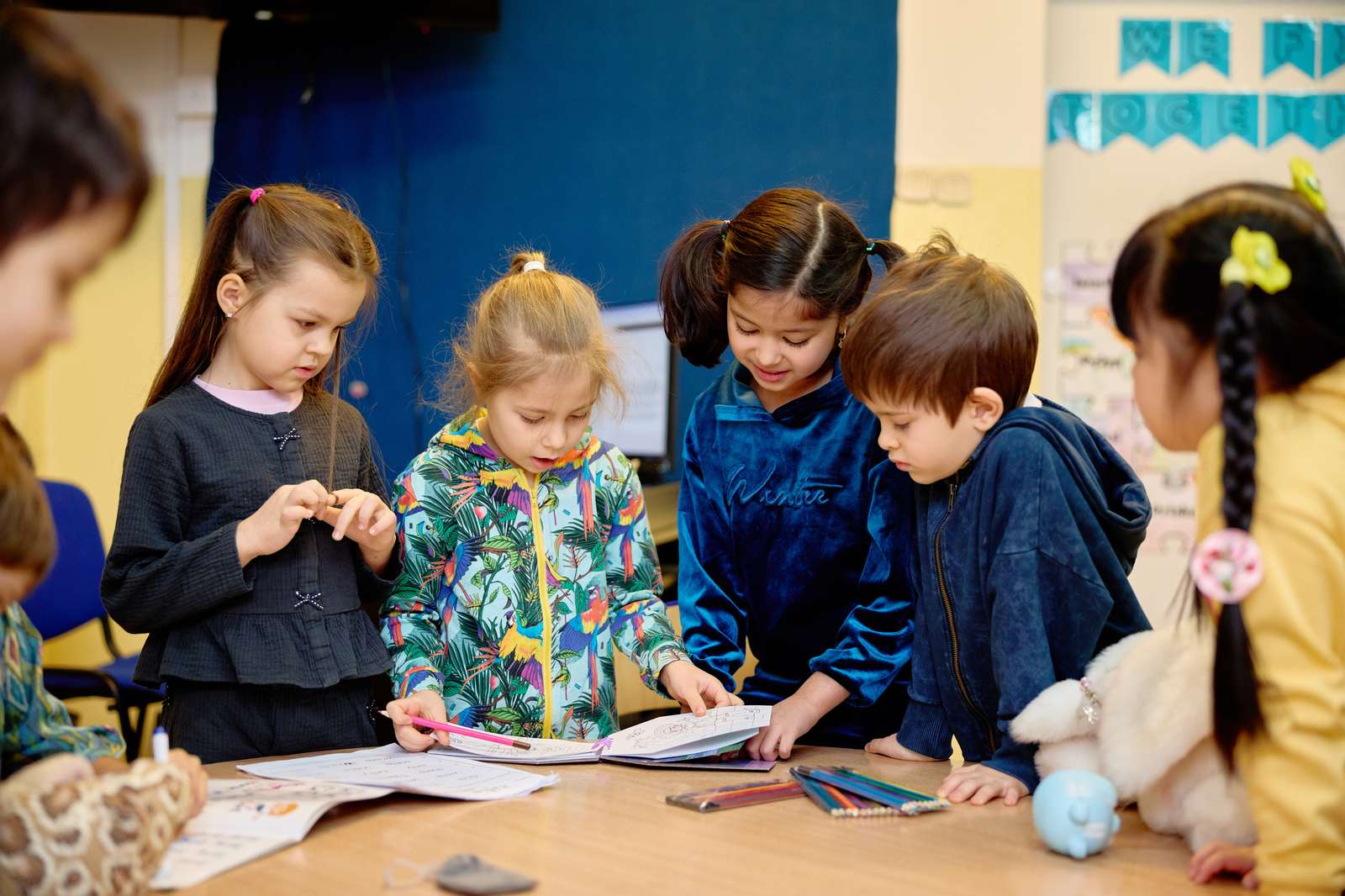
At IAS, Kindergarten is taught in English. Kindergarten at IAS takes children from four and a half to six in our Dembego 12 building in Ursynów, and because IAS teaches from Pre-KG to Grade 12, our admissions team can also tell you which group would suit a younger brother or sister.
2. Who are the teachers?
Ask who leads the group. Then ask what they trained in, what their first language is and how long they have been at the school. Ask to meet them.
IAS has 40 qualified educators from around the world, most of them native English speakers, teaching from Kindergarten to Grade 12.
3. How many children share the room?
Ask for a number. Not the school's average, which tells you little about one room of four-year-olds, but the number of children in the group your child would join this year.
Across IAS there are seven students to every teacher. Group sizes change from year to year with the intake, so ask us for the current figure for the group your child would join.
4. How long is the day, and what fills it?
Working parents need real hours. When does the door open, when do lessons end, and who looks after the children until you arrive?
The Dembego 12 building opens at 07:45, lessons run from 08:30 to 15:10, and after-school care keeps the building open until 17:00, so a parent with a full working day can drop off before eight and collect at five. Inside the day there is time for play and for rest. The group meets every day for Circle Time, with music, stories and talk, and Jolly Phonics, a method for learning the sounds of letters, runs through short activities across the day. The rest is learning by doing: early mathematics, science, art, music and physical education, all in English.
5. What will my child eat?
Ask who cooks. Ask how you order, and what happens when a child has an allergy.
At Dembego 12 the youngest children get breakfast, lunch and an afternoon snack as one daily set, cooked by Kuchnia z Klasą, which families order and pay for day by day in the iKuchnia panel, though you can also send food from home. There is no pork. Meat and vegetarian dishes are served every day. Dairy-free, gluten-free and halal meals can be arranged directly with the kitchen. Our school meals page shows the ordering steps.
6. How much time do children spend outside?
Ask where they play, and how often.
Dembego 12 has a playground built for young children, and the Kabaty Forest is beside the school. Trips go further. Children visit the Copernicus Science Centre, Łazienki Park and local theatres.
7. My child does not speak English yet. Is that a problem?
Ask how the teachers help a child who arrives with no English at all, and whether that help costs extra.
Not at IAS. Children join our Kindergarten at every level of English, including none, and teaching is in English from the first day. Our students come from more than 40 nationalities, so the teachers are used to welcoming children who are new to the language, and the office will explain how support for a child new to English works in Kindergarten and what it costs.
8. What happens after Kindergarten?
A kindergarten that stops at six means choosing a school again a year or two later. Ask where the children go next and how they are prepared for it.
At IAS, Grade 1 is in the same building. Elementary School runs from Grade 1 to Grade 5 at Dembego 12, and Grades 6 to 12 are on the same street, at Dembego 18. Kindergarten builds vocabulary, early reading and writing before Grade 1, and from there the same school continues all the way to Grade 12, where students can take the IB Diploma, the American High School Diploma or the Polish Matura.
9. What does a year cost, all in?
Ask for the full yearly figure in writing. Check whether a fee table shows the year or a single term. Then ask what is not included: the enrolment fee, meals, transport, care after lessons.
At IAS, Kindergarten tuition for 2026/2027 is 48,000 PLN per year, paid in 10 monthly instalments, with nothing due in July or August. The enrolment fee is 4,000 PLN a year and is not refunded. Meals are paid separately. So is the school bus, which families arrange directly with the operator, Little Monsters. A second child brings a 5% discount on tuition, a third 10% and a fourth 15%, and only one discount applies at a time. The fees page has the full table and a calculator.
10. Can we come and watch?
Go while the children are there. Watch how the teachers talk to them, and how the children answer. At IAS you book a visit through the form on our contact page, and we agree a time with you.
If you are weighing up whole schools as well as kindergartens, our guide on how to choose an international school in Warsaw covers diplomas, class size, English support and mid-year entry.
Talk to us about Kindergarten
Talk to our admissions team about your child. You can write to [email protected] or call +48 22 649 14 40, and if you would like to see the classrooms at Dembego 12 and meet the Kindergarten teachers while the children are there, we will arrange a visit at a time that suits you.