An international school teaches in English, follows a programme from outside Poland and leads to that programme's diploma. A bilingual school (szkoła dwujęzyczna) is a Polish school: it follows the Polish core curriculum, teaches some subjects in two languages, and its pupils go the Polish way, through the Grade 8 exam to the Matura. Either can be a good choice for a seven-year-old. They differ in how the day divides between languages, and in where they lead.
The International American School of Warsaw (IAS) belongs to the first group. We are not a bilingual school. Grades 1 to 5 learn in English at Dembego 12 in Ursynów, and the school runs all the way to Grade 12, so this guide covers both models in primary school, what happens later, and what to ask any school, ours included.
Talk to admissions, or start an application.
The differences at a glance
| International school | Bilingual school | |
|---|---|---|
| Language of most lessons | English | Polish, with some subjects also in English |
| Programme | from abroad: American, British or IB, sometimes several | the Polish core curriculum |
| Starting without English | depends on the school, so ask about language support | gentler, because most of the day is in Polish |
| Starting without Polish | Polish is not needed in lessons | harder, for the same reason |
| End of Grade 8 | depends on the school's programme | the state Grade 8 exam |
| End of school | that programme's diploma, such as the IB Diploma, an American diploma or A-levels | Polish certificates and the Matura |
| Often chosen by families who | may move again, or have universities abroad in mind | are staying in Poland and want more English inside the Polish system |
How much English a child gets in a day
Each bilingual school sets its own balance. To see it, ask for the timetable of the class your child would join and count: which subjects run in English, which in Polish, which in both.
A timetable only shows lessons. Children pick up language over lunch, in the cloakroom and at break too, so ask which language children and adults use there.
In a bilingual school, Polish usually stays the main language of the day. At IAS it is English. Polish has its own lessons. Most of our students, who come from more than 40 nationalities, are working in a second or third language.
What children learn in Grades 1 to 5
A bilingual school teaches to the same core curriculum as other Polish schools. An international school has its own programme, which decides the subjects and the way of working, and two international schools in the same city can look very different.
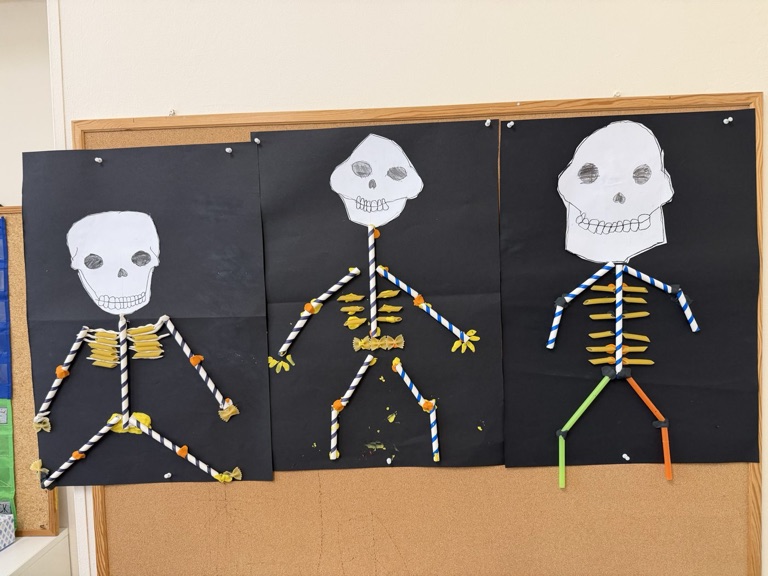
At IAS it is an American curriculum. Children study English, mathematics, science and social studies, in Grades 1 to 3 with one class teacher for most of the week, and from Grade 4 mathematics, English and science become separate subjects on the timetable. Much of the work is done by hand: this autumn Grade 3 built skeletons from straws, pasta, paper and play dough, and the STEAM club for Grades 3 to 5 set out four slices of bread to find where mould grows fastest.
IAS is an American school and also a Polish non-public school, and in the educational agreement each family signs, the school commits to teaching programmes that include the Polish core curriculum at each level.
Will my child lose their Polish?
At a bilingual school this rarely comes up. At an international school it depends on the timetable.
At IAS Polish is on the timetable four or five times a week from Grade 1, and Grades 4 and 5 add one history lesson from the Polish programme. Polish Language and Literature is followed by Polish nationals and by children with two or more years of Polish schooling, while a child who arrives without Polish learns it as a second language, and from Grade 3 those children have their own group.
What comes later: the Grade 8 exam, high school, a diploma
A pupil at a bilingual school ends Grade 8 with the state exam in Polish, mathematics and a foreign language, then moves to a Polish secondary school and takes the Matura, while at an international school the road depends on the programme and ends in its diploma. Our guide to international schools in Warsaw puts the programmes side by side.
At IAS, after Grade 5 a child moves along the street to Dembego 18, home to Grades 6 to 12. Our Middle School (Grades 6 to 8) is an MYP candidate school, which is a stage in the IB's authorisation process. High School ends with one of three routes: the IB Diploma, taught here since 2006, the American High School Diploma or the Polish Matura. Students choose in Grade 10. Those graduating with the IB or the Matura also receive the American diploma, and a student can earn all three only by completing each programme's requirements. In the May 2026 session our average IB score was 34 points, against about 30.6 worldwide.
For the Grade 8 exam, ask admissions about your child's year group.
If your child changes school
Children from Polish schools and other systems join IAS all through the year. The grade depends on age on 1 September. Admissions also looks at language, previous schooling and any additional needs, so a child is not automatically put back a year.
Going the other way, watch one thing. Polish schools count by year of birth, so the Polish class can be one lower than the IAS grade. If a return to a Polish school is a real possibility, please say so at the first conversation.
My child has little English
They can still start here. In the lower grades IAS accepts children with little or no English.
For such a child a bilingual school is the gentler beginning. At an international school English is the language of lessons from day one, so a child needs support straight away. Ask about that support most closely. At IAS the EAL team (English as an Additional Language) checks each child's level, and a student who needs help works in a group at their level, inside the normal timetable. EAL is a paid programme, and the fees page has the amounts. It helps a child reach the English they need for every subject sooner. Children in Grades 2 to 5 can join. For Grade 1, please ask admissions.
How to choose
A bilingual school usually suits a family staying in Poland for the long term, with Polish at home, who want strong English on top of the Polish road through the Grade 8 exam and the Matura.
An international school usually suits a family when:
- you may move again, and your child should be able to continue at a school in another country;
- your child has little or no Polish;
- you want English to be the language of school from Grade 1;
- you have universities abroad in mind.
Not decided yet? Ask each school which routes stay open. At IAS the Polish Matura route, recognised by the Ministry of Education, runs through the same school, even though a child learns in English from the start.
What about kindergarten?
The same difference applies to younger children. Some kindergartens run the whole day in English, some Polish kindergartens have a bilingual group or daily English sessions, and in others English is one activity a week. The label "international kindergarten" does not tell you which model you are looking at. Our guide to choosing an English kindergarten has ten questions to ask. IAS teaches from Pre-KG to Grade 12.
Nine questions for any school
Ask them at every school. They work at a bilingual school, an international school or any other:
- May I see this class's timetable? Which subjects are in English and which in Polish?
- Which language do children and adults use at break, over lunch and in after-school care?
- Who teaches the lessons in English, and how are they qualified?
- How many Polish lessons are there, and on what programme? How will my child learn the Polish words for mathematics and science?
- Do pupils take the Polish Grade 8 exam?
- Which grade does the school run to, and with what diploma does a student leave?
- What happens if in two years we leave Poland, or move our child to another school?
- My child has little English or Polish. How do you check the level, what support do you offer and what does it cost?
- What does the full year cost, in writing: tuition, enrolment fee, meals, bus, language support?
Our tuition for every grade, per year, is on the fees page.
How to start at IAS
Grades 1 to 5 learn at Dembego 12, beside the Kabaty Forest and five minutes' walk from Metro Kabaty. Lessons run from 08:30 to 15:10. Clubs follow every day, and the building is open from 07:45 to 17:00. Across the school the student-teacher ratio is 7:1. There is more on Elementary at IAS and in our guide to the international primary school in Warsaw.
We welcome new students all year round, subject to a place in your child's grade. Write to [email protected] or call +48 22 649 14 40, Monday to Friday, 08:00 to 16:00, with your child's age, current school, level of English and when you would like to start.